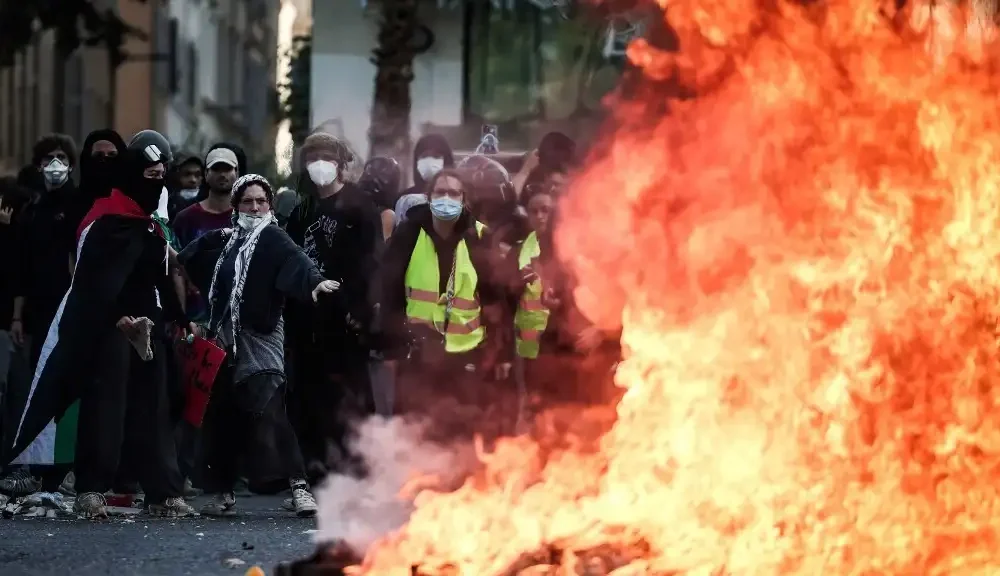
Six months before the presidential election, the riots that rocked France this weekend could benefit Marine Le Pen, pose “a risk” to Jean‑Luc Mélenchon, and “disturb” Emmanuel Macron, according to Frédéric Dabi, director-general of the French Institute of Public Opinion (IFOP), a guest on Forum on Monday.
Those riots that erupted in the streets of the country on Saturday and Sunday could “benefit” Marine Le Pen, the leader of the National Rally, whose electorate is “attached to order.”
Marine Le Pen wants to “embody the alternative to the government in power.”
He notes that there had been “a very strong brake on voting for Marine Le Pen in the 2017 presidential election,” because people thought that with her there “would be riots, violence, that France would jump into the unknown.” But, “the reality is that we do not need her election for this situation to be as explosive,” he stresses.
“When you see the chaos [the disorder], clearly, the RN voter cannot help but be even more mobilized, more loyal to the one who wants to embody this alternative to the government in power,” says Frédéric Dabi.
Un “risque” pour Jean-Luc Mélenchon
At the opposite end of the political spectrum, Frédéric Dabi sees “a risk” for Jean‑Luc Mélenchon. “He appears as the movement that most supports the student movement, the protests,” which “allows him to solidify his first-round score,” he notes.
But in public opinion, he risks being “associated with this disorder,” which could “put him in difficulty to broaden his first-round electoral base, notably recover voters from the center-left, from the Socialist electorate, from the useful vote that had allowed him in 2022 to achieve such a remarkable score.” The founder of La France insoumise had obtained 21.95% of the votes in the first round of the 2022 presidential election, narrowly missing the second round.
The left-wing social-democratic candidate Raphaël Glucksmann can, for his part, appear as “a kind of receptacle for left-wing voters shocked by the issue of disorder,” who “do not want what could be seen as leniency by Jean‑Luc Mélenchon and his allies,” continues Frédéric Dabi. “Insecurity, disorder, that has not been a theme limited to the right for a long time.”
But the question, according to him, is whether “French public opinion will dissociate the high school movement … from all this destruction, all this looting that … outrages a vast majority of French people.” He concedes that he does not have the answer.
“Very hard” for Emmanuel Macron
For the French president, “it’s very, very hard,” says the Forum guest. “In the polls we conduct, there is a dimension of the end of his reign. There is something very harsh about his record, on domestic affairs. He is rather preserved internationally.” The IFOP director also notes “a feeling among many French people that he has abandoned the national stage.”
For him, “these dimensions bother Emmanuel Macron and can bother the candidates of the presidential camp, or at least those of the central bloc, even if they are clearly in rupture, in dissonance, or in distinction from Emmanuel Macron.”
He finally notes that “the French are operating a kind of continuum between the urban riots of June 2023 following the death of the young Nahel, what happened after Paris Saint‑Germain’s victory in football, and what has happened in the last few days.”