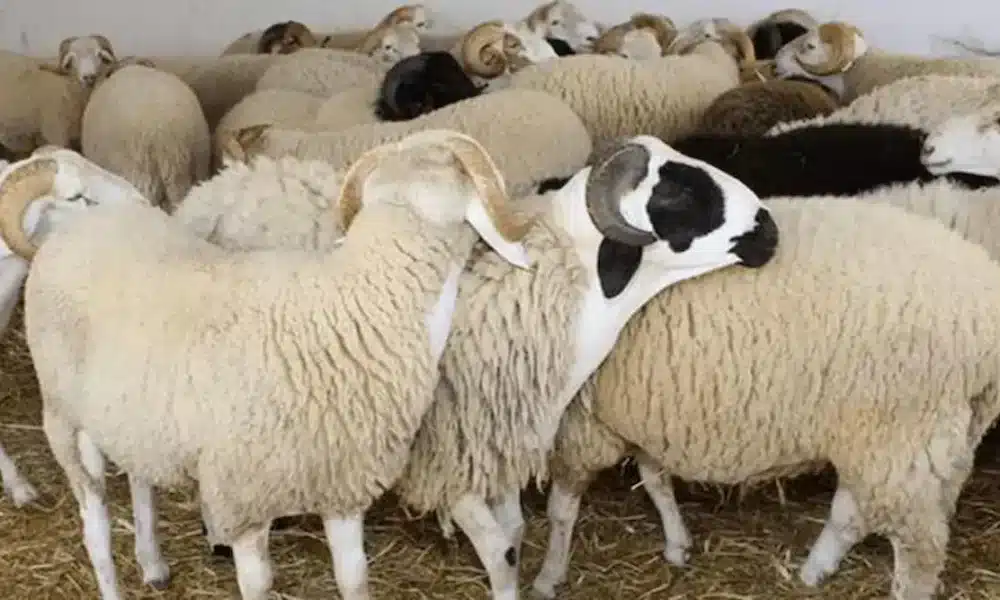
The weekly markets in the Sidi Bouzid governorate are currently experiencing strong activity, especially in the spaces reserved for the sale of Eid al-Adha sheep, despite a consensus around the excessive surge in their prices, which reaches about 500 dinars compared to last year.
Mustapha Ammar, a livestock trader, indicated in a statement to TAP, that Eid al-Adha sheep prices, though high, have recorded in the past two days a drop of about 100 dinars, due to a retreat in purchases, despite the payment of civil servants’ salaries and the increase in supply.
Regarding prices, he stated that they fluctuate between 1,400 and 1,500 dinars for a medium-sized sheep, and around 1,300 dinars for a female, while the price of a large animal can exceed 2,000 dinars. He expects a continued decline in prices over the next two days, due to the availability of a large number of sheep, as breeders are forced to sell them after the end of the fattening period and for fear of additional costs related to livestock feed.
From his side, Abdallah Ibrahim, a breeder, affirmed that despite the rise in Eid sheep prices, they often cover production costs and farmers’ efforts only with difficulty. He explained this situation by the increase in prices of livestock feed, which can reach 30%, their scarcity and the irregularity of the supply secured by specialized structures. For example, the price of 85 kg of barley exceeds 60 dinars, while the sale of concentrated feeds, notably bran and the “sedari,” is monopolized by black-market traders.
He also noted that coarse forages, such as the “qart” and the “tabaâ,” have seen a dramatic rise in their prices, with the “qart” currently sold on-site, at farms, for 25 dinars. This situation is worsened by the decline in the use of natural grazing due to climate changes, notably rainfall deficits and rising temperatures, which have forced breeders to rely more on livestock feeds.
Youssef, a breeder from Souk Jedid, called on agricultural extension services to intervene and supply vaccines and medicines, particularly during periods marked by the spread of diseases such as foot-and-mouth disease, which has caused the loss of a significant portion of the herd. According to him, the farmer has found himself alone in facing the high cost of medicines and veterinary consultation fees.
He also warned against the negative effects of anarchic slaughter on the sustainability of the stock, especially reproductive females and young animals, due to lack of control and the absence of supervision. This situation has led, according to him, to a decrease in the number of head and a slow renewal of the stock, raising fears of its progressive disappearance over the years.
The president of the Regional Union of Agriculture and Fisheries in Sidi Bouzid, Ali Brahmi, indicated, in a statement to TAP’s correspondent, that Eid sheep prices in the governorate obey the rule of supply and demand. He stressed that farmers face mounting pressures due to the sharp rise in livestock feed prices, the main factor in farming, in addition to increased transport and veterinary care costs.
He added that climate changes, particularly the weakness of precipitation and the retreat of natural pastures, have also contributed to increasing dependence on compounded feeds, which has burdened production costs. According to him, all of these factors directly affect the price of Eid sheep, forcing the farmer to sell his stock at high prices to cover his expenses and to realize a minimum profit that allows him to continue his activity.
The president of the Regional Union of Agriculture in Sidi Bouzid also stressed the necessity of preserving reproductive females and avoiding their slaughter, owing to their essential role in the sustainability of the stock at regional and national levels.
He estimated that slaughtering females constitutes a real threat to animal resources and could lead to a new rise in prices in the future. He also highlighted the quality of Eid sheep in the region, noting that the governorate is known for its high-quality agricultural production, particularly in the field of red meat. He also emphasized the important role played by farmers in ensuring the availability of these products.
It should be recalled that the number of sheep destined for Eid al-Adha in the Sidi Bouzid governorate stood at about 110,000 head in 2024, compared to 145,000 in 2023, 278,000 in 2022, 280,000 in 2020, and 347,000 in 2018. The governorate also counts more than 342,000 breeding ewes, about 27,000 producing cows, and 50,000 breeding goats, contributing 9.6% to national production, according to 2018 statistics.
For the third consecutive year, the various agricultural structures concerned, notably the Regional Commission for Agricultural Development of Sidi Bouzid, the Animal Production Service, and the Office of Livestock and Pastures, have refused to provide data or figures regarding the number of Eid sheep, the measures taken to resolve the difficulties mentioned, the campaigns planned for Eid, or the health status of the stock.