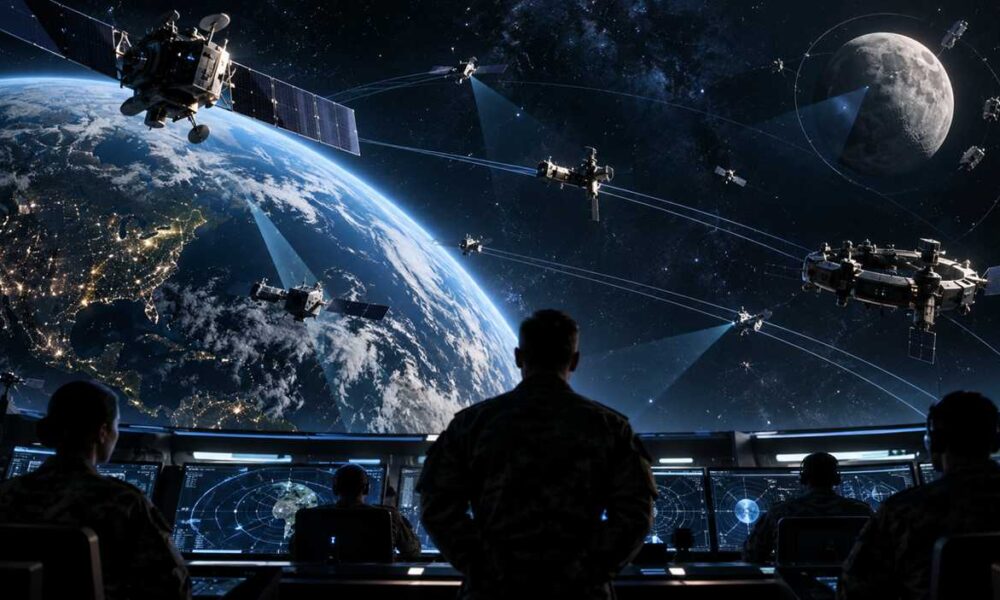
The United States is increasingly openly embracing the military dimension of space.
At National Harbor, in Maryland, the Chairman of the Joint Chiefs of Staff, General Dan Caine, urged American forces to prepare to fight beyond Earth’s orbit, into the space surrounding the Moon.
Several days earlier, the Secretary of the Air Force, Troy Meink, publicly acknowledged the existence of American “space control” weapons already deployed in orbit, without revealing their nature.
- General Dan Caine calls for the United States forces to be capable of operating and fighting up to the cis-lunar space, the area between Earth and the Moon.
- The Secretary of the Air Force Troy Meink has confirmed that the Space Force has space-control weapons already in orbit, without specifying whether they are kinetic or non-kinetic.
- The Space Force aims for about 25,000 personnel in five years, while the 2027 budget proposal calls for $71.1 billion for the space branch.
- The United States has committed since 2022 to no longer conduct destructive antisatellite tests with direct ascent generating debris.
- The Golden Dome program is also developing space-based interceptors, some prototypes described as “flight-ready.”
From Earth’s orbit to the environs of the Moon
The statements were made at the Air, Space & Cyber Conference, held from September 14–16, 2026 in National Harbor, Maryland, bringing together military leaders, defense industry officials and space technology experts.
In his September 16 address, the general Dan Caine, the United States’ Chairman of the Joint Chiefs of Staff, estimated that American forces must now be prepared to fight and resist in an operating space ranging from the depths of the oceans to the cis-lunar space.
This latter notion designates the region between Earth’s orbits and the environs of the Moon. It is gaining importance with the development of civilian and commercial lunar programs, but also with the will of great powers to protect their infrastructures, their communications and their surveillance capabilities in space.
Lieutenant General Gregory Gagnon, commander of the Space Force’s Combat Forces Command, explained that the American mission must evolve as human activity expands into deep space. He cited China among the powers whose space capabilities are particularly watched by American intelligence.
Washington officially recognizes weapons already in orbit
The most significant announcement came on September 14. In the opening remarks of the conference, the American Secretary of the Air Force Troy Meink stated, according to Air & Space Forces Magazine, that the Space Force now possessed space-control weapons in orbit capable of contributing to the defense of American forces against hostile actions.
This phrasing constitutes one of the most explicit public acknowledgments to date of the existence of U.S. systems designed as true weapons and already positioned in space.
Meink, however, declined to specify their nature, their numbers, their location or their mode of action. He did not indicate whether they were kinetic systems able to physically strike a satellite, lasers, electronic warfare means or other technologies.
Jammers rather than missiles?
Victoria Samson, director of security and stability in space at the Secure World Foundation, proposed the hypothesis that the systems referred to by Troy Meink could be space-based jammers. She notes that China and Russia are already suspected of possessing comparable technologies. It remains, however, an expert hypothesis: Washington has not disclosed the technology used.
Why space debris is at the heart of the debate
The non-kinetic systems hypothesis takes on particular significance in light of the American policy on destructive antisatellite tests.
On November 15, 2021, Russia destroyed one of its own satellites, Cosmos 1408, with a direct ascent antisatellite missile. According to NASA and American authorities, the test generated more than 1,500 debris pieces large enough to be tracked, as well as a much larger number of smaller fragments.
The debris cloud posed a serious enough threat that astronauts and cosmonauts aboard the International Space Station applied emergency procedures and temporarily sought shelter in their capsules to be able to evacuate the station if necessary.
In April 2022, the United States announced a voluntary commitment to no longer conduct destructive direct-ascent antisatellite missile tests. This decision does not constitute a ban on all antisatellite weapons: it targets destructive tests likely to create long-lasting debris in orbit.
This distinction helps explain why jamming, cyberattack or directed-energy capabilities are often considered as options capable of temporarily or permanently neutralizing a satellite without necessarily creating thousands of fragments in orbit.
China at the center of American concerns
U.S. officials frame the acceleration of their space capabilities as a response to the rise of several competitors, particularly China.
According to an assessment published by the Space Force, China had conducted 37 orbital launches in the first half of 2026, bringing the number of Chinese payloads in orbit to 1,506. The American military also estimates that Beijing has more than 510 satellites capable of intelligence, surveillance and reconnaissance missions.
These figures are American assessments. Washington also says that China is developing or operating capabilities for jamming, terrestrial antisatellite weapons, lasers and spacecraft able to perform close-quarters maneuvers in orbit.
Some of these technologies are dual-use. A satellite capable of approaching another craft can be used for inspection, maintenance or towing of a failed satellite, but the same techniques can also be adapted to military operations.
The Space Force wants to reach around 25,000 personnel
This doctrinal shift is accompanied by a broad expansion of capabilities. Created in 2019, the Space Force plans to grow its personnel to about 25,000 military personnel in the next five years.
Gregory Gagnon indicated that roughly two-thirds of the projected growth should be allocated to the Combat Forces Command to increase the number of teams and units directly deployable for space operations.
The financial effort is also substantial. The U.S. fiscal year 2027 budget proposal calls for $71.1 billion for the Space Force. Of this amount, $21.6 billion would be devoted to the various categories of space-control systems, representing a announced increase of 158% compared with the previous fiscal year.
However, this is a budget request: these amounts remain subject to Congressional approval.
Golden Dome: space interceptors already at the flight hardware stage
The growing militarization of space also appears in the Golden Dome missile defense program, which is to include a layer of interceptors positioned in space.
During the same conference, Troy Meink claimed that the Space-Based Interceptor program had moved from the “initial contract” to flight-ready hardware in less than a year.
This statement does not mean that these interceptors are already operational in orbit. The program still follows several development steps: building prototypes, demonstrating space operation, and integrating with the overall Golden Dome architecture. A first capability could be envisaged around 2028.
Not to be confused
The “space control weapons” acknowledged by Troy Meink as already in orbit and the future Golden Dome space interceptors are two distinct programs. No public element allows us to assert that the weapons already deployed correspond to the Golden Dome interceptors.
The Congressional Budget Office also estimated that a national missile defense architecture largely meeting the administration’s objectives could cost about $1.2 trillion over twenty years. This figure is not the official cost of Golden Dome: the CBO modeled a theoretical architecture due to not yet knowing the program’s definitive configuration.
What the 1967 treaty actually prohibits
The American announcement rekindles questions about international space law, but the legal framework must be described precisely.
The 1967 Outer Space Treaty prohibits placing in Earth orbit objects carrying nuclear weapons or other weapons of mass destruction. It also prohibits stationing such weapons elsewhere in space.
Regarding the Moon and the other celestial bodies, the restrictions are broader: they must be used exclusively for peaceful purposes. The treaty notably prohibits establishing bases, installations or fortifications, conducting military maneuvers, or testing any type of weapon there.
By contrast, the 1967 treaty does not establish a blanket prohibition on all conventional weapons in Earth orbit. The recognition of orbital weapons by the United States does not, by itself, prove a treaty violation. The exact nature of the system, its location and its use are decisive.
Since 2022, this legal framework has been joined by the American pledge not to conduct destructive antisatellite tests that generate debris. It is a voluntary code of conduct rather than a blanket prohibition on possessing satellite-neutralization capabilities.
Chinese, Russian and American precedents
The capabilities to destroy a satellite did not originate with the September 2026 announcements.
In 2007, China destroyed one of its own weather satellites with an antisatellite missile, generating a large cloud of orbital debris.
The United States demonstrated a comparable capability the following year during the Burnt Frost operation. On February 21, 2008, the cruiser USS Lake Erie launched an SM-3 missile to intercept the malfunctioning USA-193 satellite.
Washington described the operation as a measure to reduce the risk posed by the satellite’s hydrazine reservoir during its uncontrolled reentry into the atmosphere. The interception nevertheless demonstrated the capability of an American missile-defense system to reach a satellite in low Earth orbit.
In November 2021, Russia also carried out its destructive test against Cosmos 1408, whose debris reinforced international calls for restrictions on such tests.
Beijing and Moscow denounce a new stage of space militarization
China reacted to the American statements by affirming its commitment to the peaceful use of space. The spokesperson for the Chinese Foreign Ministry, Guo Jiakun, urged Washington to stop expanding its military preparations in space and warned against an acceleration of the arms race.
Russia also condemned the announced deployment and renewed its call for the development of a legally binding international agreement to prevent an arms race in space.
Washington, for its part, presents its new capabilities as means of deterrence and protection of infrastructures that have become essential to modern military operations: communications, geolocation, intelligence, surveillance and missile warning.
The Moon integrated into the American strategy
Caine’s reference to space around the Moon fits within a policy already formalized by the American administration.
A decree signed by Donald Trump on December 18, 2025 calls on American administrations to develop the capability to detect, characterize and counter threats ranging from very low Earth orbit to cis-lunar space.
The text also sets the objective of returning American astronauts to the Moon in 2028 and of beginning to establish the first elements of a permanent lunar presence from 2030.
The American logic thus increasingly tightly links exploration, space economy, missile defense and protection of orbital infrastructures.
A space military competition now more visible
Thus, the September 2026 novelty is not the sudden appearance of a space military competition. It has existed for several decades and concerns both reconnaissance satellites and jamming means, cyberattacks, antisatellite missiles or orbital rendezvous technologies.
The change lies more in the degree of transparency adopted by Washington: a senior American official now explicitly acknowledges that the Space Force has space-control weapons already in orbit, while the command openly prepares its forces for operations that may extend beyond Earth orbit.
Yet a major unknown remains: the nature of these weapons. Until Washington provides further details, it will be impossible to determine whether the systems involve electronic warfare, directed energy, physical interception capabilities, or a combination of several technologies.
What to rememberThe American announcement marks above all a change in public doctrine: Washington now acknowledges weapons in orbit and explicitly prepares its forces for operations up to cis-lunar space. But international law does not ban all conventional weapons in Earth orbit; the United States maintains its commitment against destructive antisatellite debris-generating tests, and the exact technology of the systems already deployed remains secret.